
HIV-Tocky system to analyze proviral expression dynamics
Points
- Transcriptionally silent yet replication-competent HIV-1 proviruses persist within infected cells, forming latent reservoirs, which remain a formidable barrier to
- Latent reservoirs are highly heterogeneous, comprising proviruses that differ in integration site, epigenetic context, transcriptional competence, and inducibility.
- Conventional HIV reporter viruses rely on long-half-life fluorescent proteins (e.g., GFP), which obscure transient transcriptional events and fail to resolve the temporal history of proviral expression.
- As a result, critical early events during latency establishment, transcriptional shutdown, and reactivation remain poorly defined at the single-cell level.
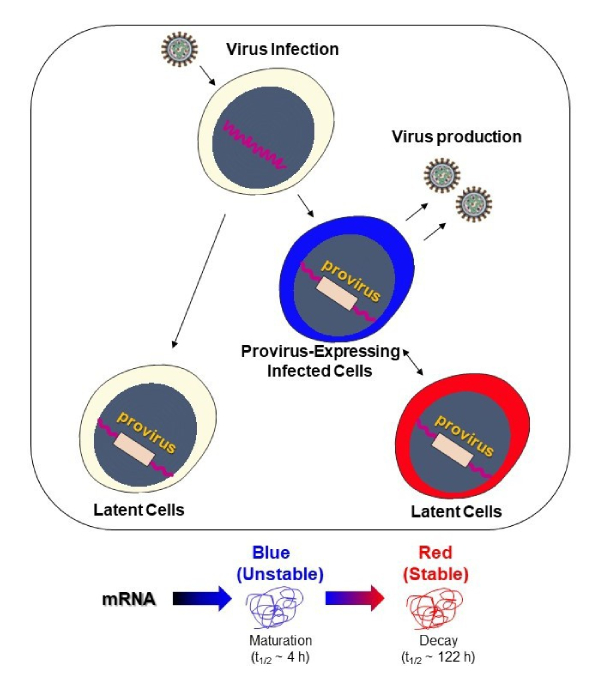
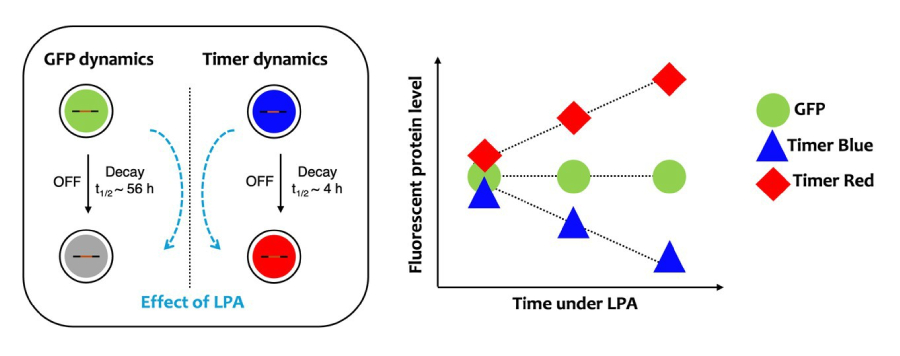
- The HIV-Tocky system uses a fluorescent Timer protein that spontaneously shifts from blue to red fluorescence in accordance with provirus reactivation status, enabling temporal tracking of proviral expression.
- This system distinguishes early actively transcribing, persistently expressing, and recently silenced proviruses in the infection model.
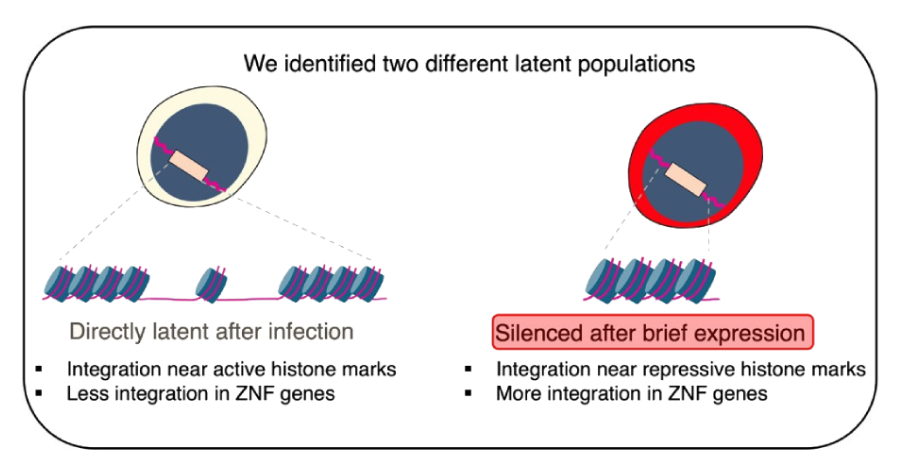
- The HIV- Tocky system allowed for the first time, the identification of two latent patterns: a direct latency, and a latter latency which initially shows transient
- HIV-Tocky reveals heterogeneity in proviral expression states that are not detectable with conventional reporters.
- The system usage is currently being expanded in primary human CD4⁺ T cells and in vivo mouse models.
RESEARCH SUMMARY
HIV-1 latency remains a central barrier to curing HIV infection. Although antiretroviral therapy effectively suppresses viral replication, integrated proviruses can persist in a silent state and re-emerge upon treatment interruption. Understanding how proviruses transition between active transcription and latency is therefore essential for developing strategies aimed at reservoir elimination or durable silencing.
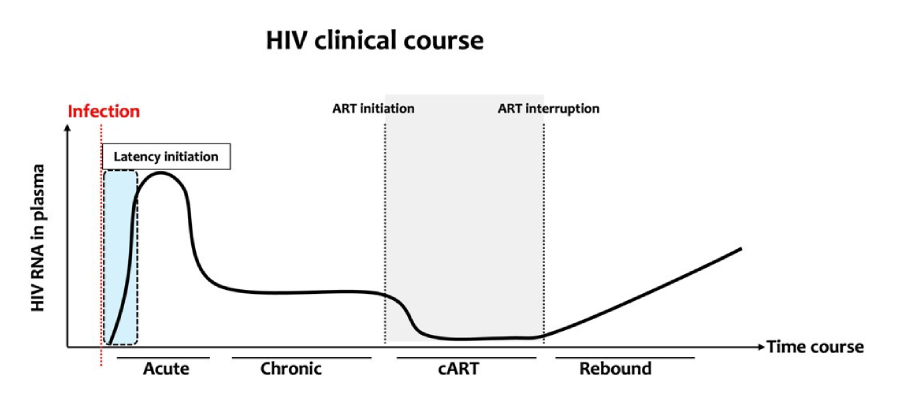
To address the limitations of traditional reporter systems, this study developed the HIV-Tocky system, a time-resolved reporter that captures the dynamic history of HIV-1 proviral expression. By exploiting a fluorescent protein that spontaneously changes its emission spectrum from blue to red in synchronization with provirus expression patterns, HIV-Tocky enables direct visualization of proviral transcriptional history following viral entry, allowing discrimination between recent transcriptional activation, sustained expression, and transcriptional silencing within individual infected cells.
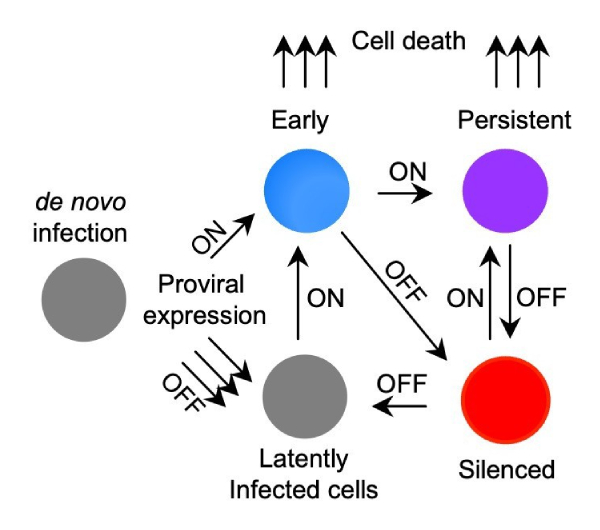
Using the HIV-Tocky system, we analyzed the process of latency establishment following HIV-1 infection and identified two distinct latent populations; One entered latency rapidly without detectable expression, whereas another population underwent an initial phase of active proviral expression prior to transcriptional silencing. These two populations or routes into latency were associated with different integration characteristics.
Finally, we further generated multiple HIV-Tocky–infected clonal cell lines and determined their proviral integration sites and full-length viral sequences. Compared with conventional GFP-based reporter systems, the HIV-Tocky clones enabled more sensitive detection of transcriptional shutdown in response to latency-promoting compounds, reflecting the Timer reporter’s efficient ability to capture dynamics of provirus silencing.
PUBLICATION INFORMATION
Title: HIV-Tocky system to visualize proviral expression dynamics
Authors: Omnia Reda, Kazuaki Monde, Kenji Sugata, Akhinur Rahman, Wajihah Sakhor, Samiul Alam Rajib, Sharmin Nahar Sithi, Benjy Jek Yang Tan, KokiNiimura, Chihiro Motozono, Kenji Maeda, Masahiro Ono, Hiroaki Takeuchi, Yorifumi Satou
Journal: Communications Biology
DOI: 10.1038/s42003-024-06025-8

